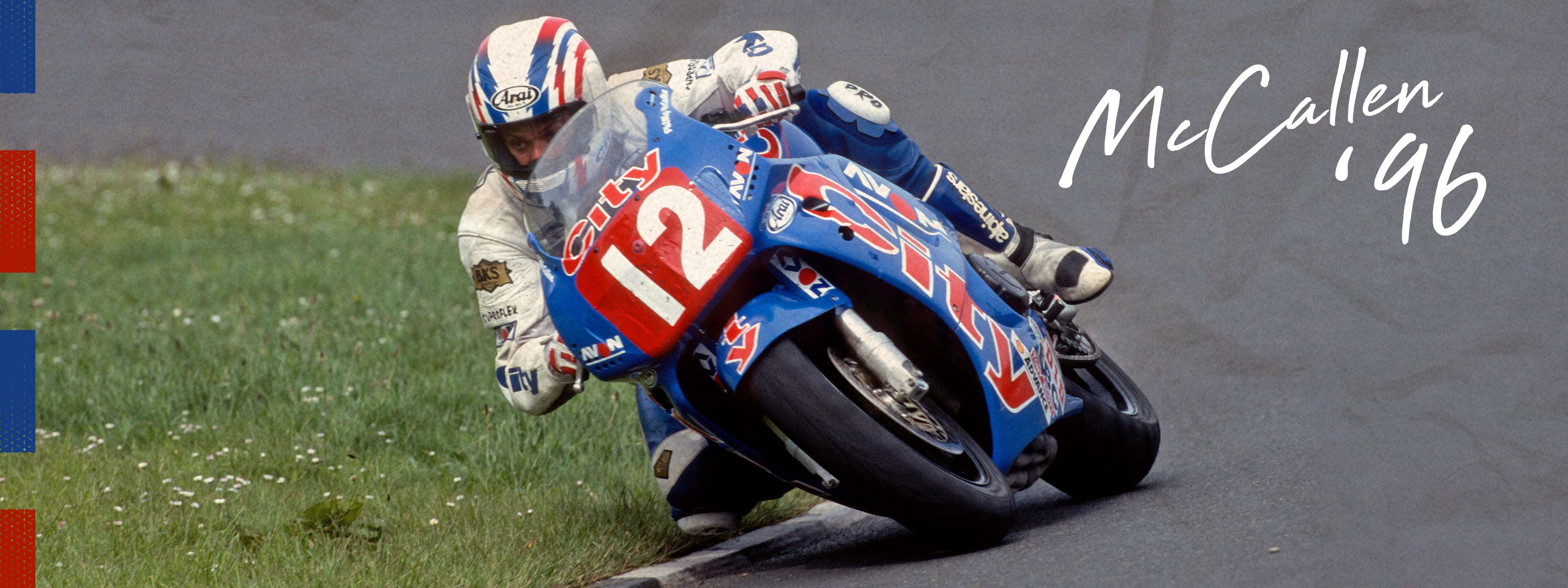
“I WANTED FIVE”: PHIL MCCALLEN’S MEMORIES OF 1996
The 1996 Isle of Man TT Races has largely been remembered recently for the debut appearance of eventual 23-times winner John McGuinness, but while the young Morecambe Missile was enjoying his first Mountain Course experience aboard the Paul Bird Motorsport Honda RS250R, a certain Phillip McCallen was in the midst on his own record-breaking journey.
Having been born a stone’s throw from the Tandragee circuit in Northern Ireland, McCallen literally grew up to the sights and sounds of road racing. First going racing in 1984, five years later he had earned himself a coveted seat in the works Honda squad after a debut to remember on the Isle of Man.
Arriving on the Island for the first time to contest the Manx Grand Prix in 1988, he broke records from the outset, winning both the Lightweight race for Newcomers and Manx Grand Prix proper - the first person to win both a Newcomers and Manx Grand Prix race in the same year. Impressing the Honda bosses, McCallen graduated to the TT with the works team in 1989, achieving a best finish of seventh in the Ultra Lightweight TT.
In 1991, McCallen made two trips to the podium before securing his first victory in the 1992 Formula 1 TT, which he then backed up with a second win in the Supersport 600 TT later in the week. Further victories in the 1993 Senior and 1995 Formula 1 TTs meant McCallen arrived for the 1996 TT fortnight with four wins to his name and was being tipped for more success from those in the know in pre-event previews.
“I knew four was doable,” says McCallen, thinking back thirty years. “I actually should have won five in 1996, not four. It really started in 1992 when I got my first win here. I was always feeling good and there was no problem. In my first Formula 1 TT I beat Steve Hislop and Carl Fogarty, then I came back again on the Wednesday and beat them again on the 600.
“I was top tuned for Friday’s race but of course that’s now the famous race between the Norton and the Yamaha. My radiator bust in the first lap so I never got to be a part of that race. That might be for the good or the bad as I probably would have tried too hard, or rode too hard, to be a part of that battle. I ended up having the fastest RC30 around this island, the only two people slightly faster were Hizzy and Foggy.
“I was always confident around here, I always liked it and always loved it. I had a bit of bad luck in 1993, I can’t quite remember what happened in ‘94 and in ‘95 I was racing in the World Thunderbikes at the time so I had to jump in and out, and slid off the flipping 600 at the Waterworks in 1995 while fighting for the lead in that one. Just a silly mistake. I won the F1 race and then I was away, so that was ‘95.”
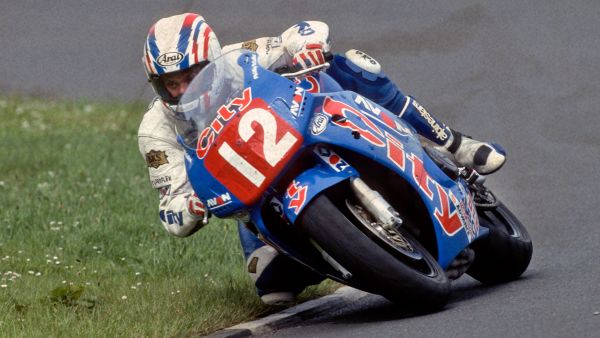
McCallen on his way to a third victory of the week in the 1996 Production TT.
The level of success that he brought to the table for 1996, though, was unprecedented. Kicking off the week in fine style, McCallen stormed to victory to lead a Honda Britain 1-2 with Nick Jefferies coming home second. Jefferies followed McCallen across the line on the road, but by virtue of their starting positions, the margin was actually 50 seconds on the results sheet, such was McCallen’s commanding performance.
After a fourth place finish in the Lightweight TT two days later, it was Wednesday afternoon’s Junior TT where McCallen was straight back on form, winning the Junior TT by 17 seconds from the V&M Honda duo of Scots Iain Duffus and Ian Simpson. Honda utterly dominated proceedings, with the top five riders all campaigning the CBR600F. It would be Friday, though, where McCallen really turned heads.
A close fought Production TT in the morning saw McCallen stretch his week’s tally to three, narrowly beating Duffus to the line by less than ten seconds. In what was a close race in general, such was the nature of Production racing, both McCallen and Duffus had to content with picking their way through slower riders as a result of their relatively low starting numbers of 12 and 15 respectively.
“Starting lower down the field didn’t bother me,” he explains. “You do it every day anyway. You just don’t adjust to their speed, and in those days I was fit enough to just work my way past them. I didn’t really care if I had someone to chase or not, really. I could ride by myself if I wanted to. It probably did make it a little bit more exciting, catching people and passing them so you don’t get bored - not that you would have got bored anyway! But it was about the love of racing here. I wanted miles here. I wanted fun, I wanted to ride bikes, I wanted to race, so I was getting everything.”
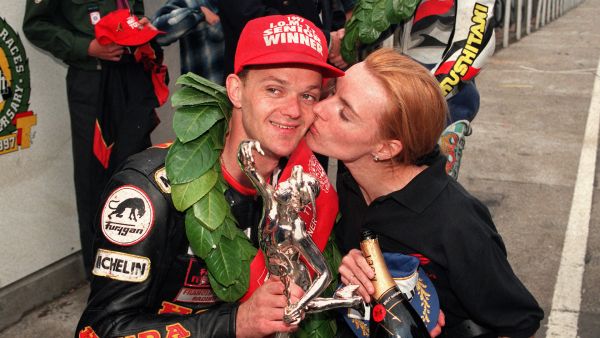
The Senior that afternoon though, was a totally different story. McCallen’s form was even stronger than he had shown in the Formula 1 race at the start of the week. Honda Britain also went one better than their Monday performance and secured all three positions on the podium. Joey Dunlop and Nick Jefferies enjoyed a close fight for the bottom two steps, but McCallen eased his way to victory as he crossed the line with a winning margin of one minute and 12 seconds.
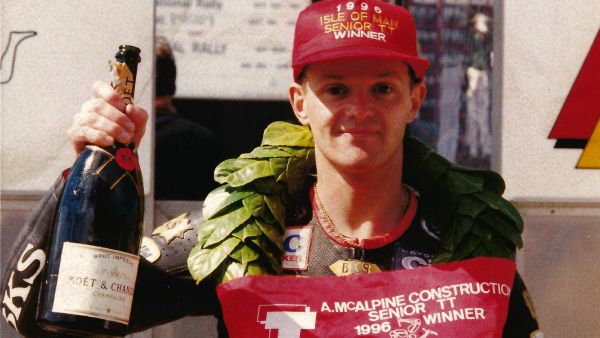
Four wins in one week – McCallen celebrates his 1996 Senior TT triumph.
“It’s a brilliant feeling and it’s not very often in life you get a chance to do that,” says McCallen when remembering the challenge of controlling the margin at the head of the field. “Michael Dunlop, John McGuinness and Peter Hickman have had the thrill to control the race, there’s a real strategy behind all this. I heard Hicky talk about it recently, and something that resonated with me was when he said the strategy was always to start off and win the races as easily as he could. Thinking about winning five North Wests in a day, you have to save energy. You win that first race but you know you’ve got loads left, even after the second race you’ve still got loads left. It was all timed out to perfection, to the point where you’re basically collapsing off the bike on the last lap of the last race.”
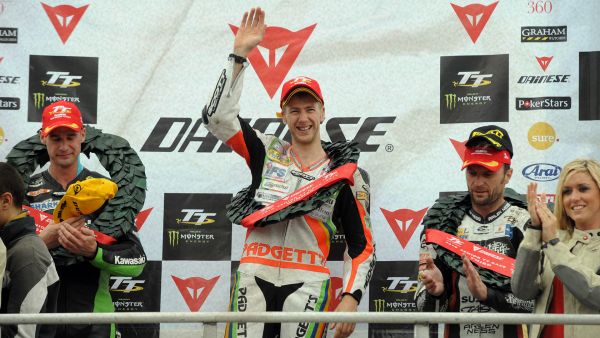
Ian Hutchinson eclipsed McCallen's record with five wins in a week in 2010.
The four-in-a-week milestone had been cracked for the first time, and it would be another 14 years before anyone would achieve the feat again, with Ian Hutchinson going one further in 2010 to take the record away from McCallen. Since then, only two other riders - Michael Dunlop and Peter Hickman - have achieved four wins in a single TT. For McCallen, though, instead of celebrating a new record, he still looks back on that week as a week of what could have been.
“In 1996 all things were taking shape and all my bikes were fit for it,” explains McCallen. “I ran out of petrol on the Mountain in the 250 race, so if that had been right I might have had five in ‘96. I’d already won five North West 200 races in one day, which no-one else had done, and I’d won five Ulster Grands Prix in one day, so my dream was to win five TTs in a week. I’d won the four, and those were all hard earned wins but there comes a point in life where you realise that sometimes things are not supposed to happen. I tried in 1996 and almost did it, in 1997 I almost did it again, in 1998 my back was broken - my bikes won but I didn’t - and in 1999 I struggled with injuries - it just wasn’t supposed to happen.”
A further three wins in 1997 would take McCallen’s total to 11 victories at the Isle of Man TT, which sees him still hold 11th in the list of all-time winners. Over a third of McCallen’s TT successes came in the space of five days, and his achievement across road racing are legendary - including five wins in six starts at the North West 200 in 1992 and winning five races in a single day at the Ulster Grand Prix.
McCallen's 11th and final TT victory came in the 1997 Senior TT.
After a career spent with Honda, McCallen switched to Yamaha for the 1999 season having fallen out with his previous employers. With promising results at the Tandragee 100, the year got off to a strong start, but would all come crashing down after an accident at Donington Park for the first round of the British Championship. Falling in the opening race, McCallen was collected by another rider, who’s front wheel ripped the 11-time TT winners’ shoulder blade, which he’d had troubles with dating back to an accident at Daytona in 1992, clean off of his back.
A further exaggeration to the injury came at the North West 200 and a heavily strapped up McCallen arrived on the Isle of Man desperate to prove a point after his move to Yamaha, injured or not.
“It turned out to be a complete disaster,” is the honest assessment McCallen gives today. “I was embarrassed and ashamed about it because I couldn’t ride. When I got here I had all this treatment, my shoulder blade was strapped up to try and hold it all to my back but it just went wrong because the shoulder joints started to expand. I didn’t know at the time but I was starting to get nerve damage, which meant the feelings weren’t there, which in turn meant I couldn’t get the bikes to handle, I couldn’t ride them. I did the first race [the Formula 1 TT] and got a slide and that was that over. I pulled out of the other races because I just wasn’t going to be safe or fit to ride. I had to do something because I was frustrated so I saved all my energy and went into the Production race on the Friday. I got a third, and while I was pleased to get on the rostrum and finish off the week on the rostrum, I felt like I’d let everyone down.
“I was deciding anyway at that time that I wanted to stop while I was still winning. I loved it, but it’s a very dangerous game and the longer you extend that out and out, the greater risks that are involved. When you look at the North West I was beating the best of people, I was setting lap records and doing stuff that other people weren't doing. At that point there’s a risk and that risk was getting higher. I loved it, but I was always going to be happy. I’m an engineer by trade, that’s what I was going to go back to doing, and everything was good. There was no reason why I had to keep racing except for love and the love was to win five races. Had I won five races in ‘97, ‘98 or ‘99 I probably would have stood up here on the Friday and said “that’s it, all over”. I never got the chance to do that, but I was close.”